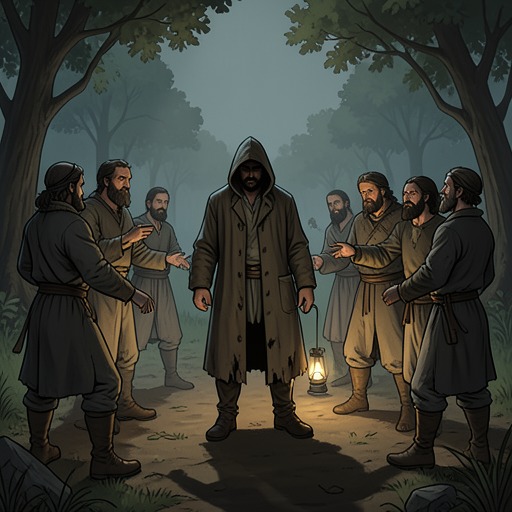
Aeron and Arnorr
The Ballad of the Last DragonAeron and Arnorr are defined by a brotherly conflict that continues after Aeron’s death. Their relationship is not presented through a direct exchange in this episode; instead, it is reconstructed through the expedition’s arguments about Aeron’s wishes, his family’s honor, and the payment that may depend on Arnorr accepting the survivors’ account. Arnorr therefore becomes both a personal rival in memory and the external authority before whom Aeron’s life must be vindicated.
Identity and Source of the Conflict
Aeron’s quest was bound to his desire to restore his honor and earn a rightful place in history and in the legacy of his family. The conflict with Arnorr grows from that aspiration: Aeron’s death has not ended the question of whether his pursuit was noble or foolish, because his surviving companions still expect his brother to judge the result. The expedition’s proposed continuation is consequently more than a search for a dragon. It is an attempt to decide what Aeron’s name will mean when it returns to the family that rejected or failed to honor him adequately.
Arnorr’s position is also connected to money. Aeron had been fully outfitted for the journey and carried the first half of the group’s compensation, while the second half was supposed to be collected after the companions brought news of his heroic death to his brother. Because no certainty exists that Arnorr will honor an agreement made in Aeron’s name, the brothers’ conflict has a material dimension as well as an emotional one. The survivors must seek recognition from a man who may control the practical value of Aeron’s final achievement.
Aeron’s Death and the Decision to Continue
After the ambush, the group considers whether abandoning the quest would be the safer and more honest response to Aeron’s death. The narrator rejects that option, arguing that quitting would betray the dead man’s expressed purpose. Aeron wanted to restore his honor, reclaim his place in history, and return home to a hero’s welcome; continuing toward the dragon is presented as the only way to make those wishes real rather than allowing his death to stand as the final evidence against him.
This argument places Arnorr at the center of the expedition even while he remains offstage. The surviving companions plan to complete Aeron’s quest, bring honor to his name, and ultimately bring the news of his heroic death to his brother. In this sense, the journey becomes a deferred confrontation between the dead Aeron and the living Arnorr: Aeron’s companions will offer the completed quest as a reply to whatever judgment Arnorr might make about his brother’s life.
Honor, Legacy, and Compensation
The narrator’s proposal to Jaromir explicitly combines glory and coin. The expedition already has supplies, a destination, and funding, including the money Aeron carried for the journey. Using those resources is defended as a continuation of Aeron’s mission rather than theft, because the funds would be spent in pursuit of the task he considered central to his life. The distinction matters: the companions are not merely exploiting a corpse, but neither are they free from self-interest.
The planned payment sharpens the ethical uncertainty. The group expects to receive the second half of its compensation when it reports Aeron’s heroic death to Arnorr, yet the narrator admits that this is the weakest part of the plan because Arnorr may refuse to pay. Cadoc doubts that Arnorr will give them even a copper, while still agreeing that Aeron would have wanted the quest completed. The brothers’ conflict thus becomes a test of whether family honor can be converted into responsibility: Arnorr may be asked to recognize Aeron’s achievement, but the companions also need him to attach financial consequences to that recognition.
The Brothers’ Conflict as a Continuing Quest
The decision to fight Aeron’s dragon turns the expedition into an act of posthumous loyalty and an answer to family repudiation. The narrator frames the intended outcome in three linked terms: finding the dragon, restoring Aeron’s honor, and confronting his brother’s judgment. The quest’s objective is therefore both external and symbolic. The dragon represents the achievement Aeron sought, while Arnorr represents the family history into which that achievement must be admitted.
The relationship’s dramatic force comes from this absence. Arnorr does not need to appear for his authority to shape the survivors’ choices; his anticipated refusal, his possible control of payment, and his place in Aeron’s family make him a constant pressure on the conversation. By pledging to bring Aeron honor and fight his dragon, the narrator accepts responsibility for carrying a dead companion’s unfinished ambition into the future. The brothers’ conflict consequently survives as a struggle over narrative ownership: whether Aeron will be remembered as a failed claimant to family honor or as the hero whose companions completed what he began.